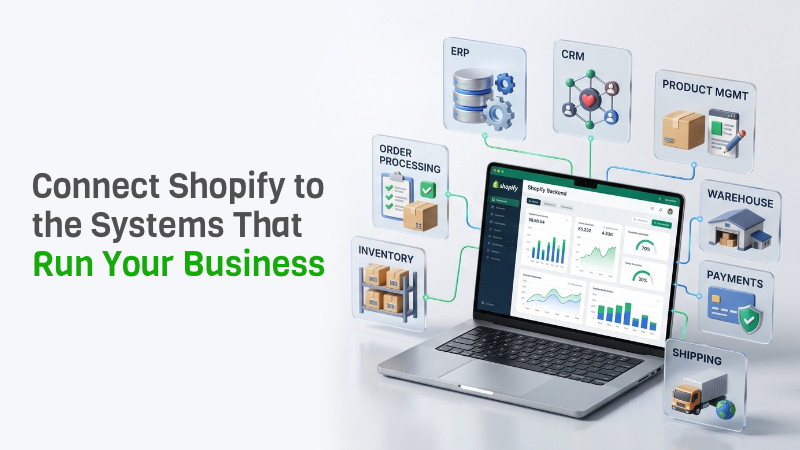
A Shopify store rarely works alone. Product information may live in a PIM, financial records in accounting software, inventory in an ERP or warehouse system, and customer communications in a CRM. When these systems do not share accurate data, teams spend time fixing errors, and customers can see outdated information.
Backend development connects Shopify with the services behind the business. A reliable integration can move the right data at the right time, give teams better visibility, and reduce repetitive manual work.
What backend development covers
Backend work includes server-side services, APIs, databases, scheduled jobs, and event processing. For Shopify, it often involves the Admin API, webhooks, authentication, and secure connections to other software. Unlike theme code that runs in the storefront, backend services can handle protected credentials and business logic outside the customer’s browser.
The right architecture depends on data volume, timing, the connected systems, and how errors should be handled. A simple scheduled export may be sufficient for one workflow; a near-real-time integration with several systems may need queues, retry logic, monitoring, and a clear source of truth for each data type.
Common Shopify integrations
ERP and accounting systems can receive orders, refunds, taxes, and payout-related information. Inventory and warehouse platforms can synchronize stock levels, transfers, and fulfillment updates. CRM and marketing tools can use customer and order information according to the merchant’s consent and data policies. PIM systems can manage product descriptions, attributes, and media before publishing to Shopify.
Other projects connect Shopify with shipping, returns, procurement, subscriptions, loyalty, or business intelligence platforms. Shopify’s Fall ’26 Editions highlights developer capabilities such as purchase-order data access and app events in analytics, which may help support some of these workflows where the feature is available and appropriate.
Design the data flow before writing code
An integration should define which system owns each field. For example, one platform may be authoritative for product descriptions while another owns available inventory. Without agreed ownership, two systems can overwrite each other or create loops of repeated updates.
A useful discovery phase maps the records, identifiers, update frequency, and failure behavior. The team should decide how to handle missing fields, changed products, cancelled orders, partial fulfillment, refunds, and duplicate events. This planning prevents expensive confusion after launch.
Use APIs and webhooks carefully
Shopify APIs provide structured ways to read and update store data. Webhooks can notify an app when selected events occur, so the backend can react without repeatedly polling the store. An integration should verify incoming webhook requests, acknowledge them appropriately, and process events safely even if they arrive more than once or out of order.
API limits and temporary service failures are normal operating conditions. A durable integration uses sensible retry behavior, avoids creating duplicates, records what happened, and gives operators a way to identify and resolve stuck work. The exact implementation should follow Shopify’s current API guidance and the connected system’s requirements.
Security and access control
Backend services often handle sensitive business data and credentials. Access should be limited to the scopes the integration actually needs. Tokens and secrets should be stored securely, not exposed in storefront JavaScript or committed to source code. Logs should help teams diagnose issues without unnecessarily recording personal or payment information.
A security review should consider who can install or configure the integration, how access is revoked, how credentials are rotated, and what happens if a service is compromised. These decisions are part of the design, not an afterthought.
Monitoring and operational ownership
An integration is not finished when data moves successfully once. Teams need visibility into job status, event delivery, failures, and unusual volumes. Alerts should point to actionable problems, while dashboards or reports can show whether the integration is keeping pace.
The handover should document system ownership, expected data timing, retry behavior, known limitations, and escalation steps. It should also explain who maintains the integration when Shopify or a connected vendor changes an API.
Backend services for headless and AI-enabled commerce
Headless storefronts and mobile apps may need backend services for customer-specific data, search, pricing, or other capabilities. Shopify’s Fall ’26 Editions describes Hydrogen features for production storefronts and new agent-facing shopping capabilities such as product discovery and cart workflows.
These options can expand how shoppers reach a merchant, but they also make clean product data and reliable APIs more important. Agentic commerce features may be in beta or limited release, so businesses should confirm access and requirements before making them part of a committed launch plan.
Consider backend development when teams repeatedly enter the same data in multiple systems, inventory or order information drifts, fulfillment exceptions are hard to see, or reporting takes too long to assemble. A short integration assessment can distinguish a configuration issue from a genuine need for custom software.
The best project may be a single reliable data flow rather than a large platform rebuild. Starting with one high-value workflow makes it easier to validate the design and measure the operational benefit.
Closing
Strong Shopify backend development makes the systems behind commerce work together predictably. By defining data ownership, building secure API and webhook flows, and planning for monitoring and recovery, a business can spend less time reconciling information and more time serving customers.
Call to action
Need Shopify connected to your ERP, CRM, inventory, or fulfillment platform? Our agency can map your current data flows, identify the main reliability gaps, and scope an integration around your business operations. Contact us to start the conversation.
Suggested further reading
Shopify Editions Fall ’26: https://www.shopify.com/editions/fall2026